
Unlock your Knowledge!
ESSENTIAL GUIDE TO
NEEDLE FELTING
Everything you need to know to start needle felting.
From materials to your first creation — step by step.
Contents
What you will learn
What is it?
The right place to felt!
Needle felting is a craft technique that uses special needles with tiny barbs to tangle and compact wool fibres, transforming them into felt. It is a dry felting technique — no water or soap needed.
With it, you can create 3D dolls, 2D wool paintings, fairies, animals, flowers, decorations and much more.


The essentials
Materials to get started
You need very little to begin: combed merino wool (Lã Mágica®), 3 felting needles (coarse, medium and fine) and a sponge base.
Optionally: safety eyes, needle holders, special needles (spiral, reverse) and wire for armatures.
View Kits >The Needles
Types and sizes
The lower the gauge number, the thicker the needle.
Knowing when to switch is essential.
- C
Coarse Needle
32 Gauge · TriangularStarts the work by catching more fibres. Builds the basic shape of the piece. Switch when you feel resistance — forcing it may break the needle!
- M
Medium Needle
36 Gauge · TriangularThe most used one! Ideal for building, shaping and defining forms. It will be your main needle for most of the work.
- F
Fine Needle
38 Gauge · TriangularFor finishing touches and details. Smooths the surface, attaches small elements and gives the final touch to your pieces.
- XF
Extra Fine Needle
40 Gauge · SpiralFor projects that require a lot of precision — doll faces, animal details and miniatures.
- R
Reverse Needle
Extra Fine · SpecialIts barbs are reversed — it pulls fibres out instead of pushing them in. Ideal for fur, hair and fluffy texture effects.
Step by Step
Your first project
Start with the basics — a felted wool ball. It is the foundation of many creations and perfect for learning the technique.
-
Prepare the wool
Separate a portion of wool and gently pull it apart to loosen the fibres. The looser it is, the easier it will be to work with.
-
Roll it into a ball
Roll the wool over itself to form a ball. It does not need to be perfect — tuck the loose ends inward.
-
Poke with the coarse needle
Place it on the sponge and poke with the coarse needle. Use straight vertical movements. Turn it and poke all around.
-
Switch to the medium needle
When you start feeling resistance, switch to the medium needle. Keep compacting and refining the shape.
-
Finish with the fine needle
Use the fine needle to smooth the surface and add the final finish. Poke gently and evenly.
-
And now? Create!
From a simple ball, you can make heads, bodies, animals… Combine shapes and let your creativity flow!
Basic Principles
Essential felting shapes
Mastering these four shapes is the secret to creating any piece. Each basic shape is a starting point for more complex projects.

★ The Ball
The most fundamental shape. Base for heads, bodies and many round elements. Roll, poke and turn evenly.
★ The Cube
Learn how to create defined edges and flat surfaces. Use "sandwich cards" to press and define the corners precisely.
★ The Flat Base
Essential for creating felt "canvases" for 2D wool paintings, bases for compositions and decorative surfaces.
★ The Roll
An elongated cylindrical shape, perfect for arms, legs, tails and other long elements in your creations.
Tips & Tricks
Techniques for the next level
Once you master the basic shapes, these techniques will raise the quality of your pieces.
▸ How to Use Templates
Print the pattern/template and use it as a reference to check the size of your piece while you work. If it is too large, poke toward the centre to reduce it.
▸ How to Apply Colour
Tear the coloured wool around 10 times to create very fine fibres. Apply it to the surface with the fine needle, poking gently and superficially.
▸ How to Draw Lines
Twist a thin strand of wool between your fingers to form a "thread". Position it on the piece and attach it by poking with the fine needle along the desired line.
▸ When to Stop
Your piece is ready when it feels firm to the touch and holds its shape without collapsing. The surface should look smooth and even, with no visible loose fibres.
Attention!
Common mistakes and how to avoid them
⚠️ Always vertical
Never bend the needle inside the wool — the barbs catch the fibres and the needle will snap.
⚠️ Rotate the piece
Keep rotating and poking from all sides to achieve an even shape.
⚠️ Watch your fingers
The needles are very sharp! Use leather finger guards, especially when starting out.
⚠️ Use enough wool
Wool shrinks 2 to 3 times as it compacts. Always use more than you think you need.
⚠️ Do not rush
Felting is meditative. Pressing harder does not make it faster — it only breaks needles.
⚠️ Switch in time
When you feel resistance, change needle. Pushing on is the number one cause of broken needles.

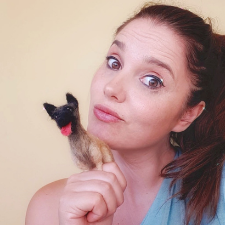
About the Author
Ready to Felt?
Start your journey
Visit the shop and find complete beginner kits, Merino wool in 40+ colours and free courses.