
Artisanal felting is an ancient technique that transforms wool fibers into solid, textured, and surprisingly versatile pieces. Whether through needle work, water, or integration with fabrics, this process reveals the enormous potential of a natural fiber that has accompanied humanity for thousands of years.
In this article, we explore the world of wool and the main felting techniques — needle felting, wet felting and nuno felting — in a simple, practical, and accessible way. You’ll discover what makes wool so special, how to choose the ideal type for each project, and the first steps to start creating with confidence.
Get ready to dive into a sustainable, expressive material full of possibilities.
What Is Wool and Why Is It Perfect for Artisanal Felting?
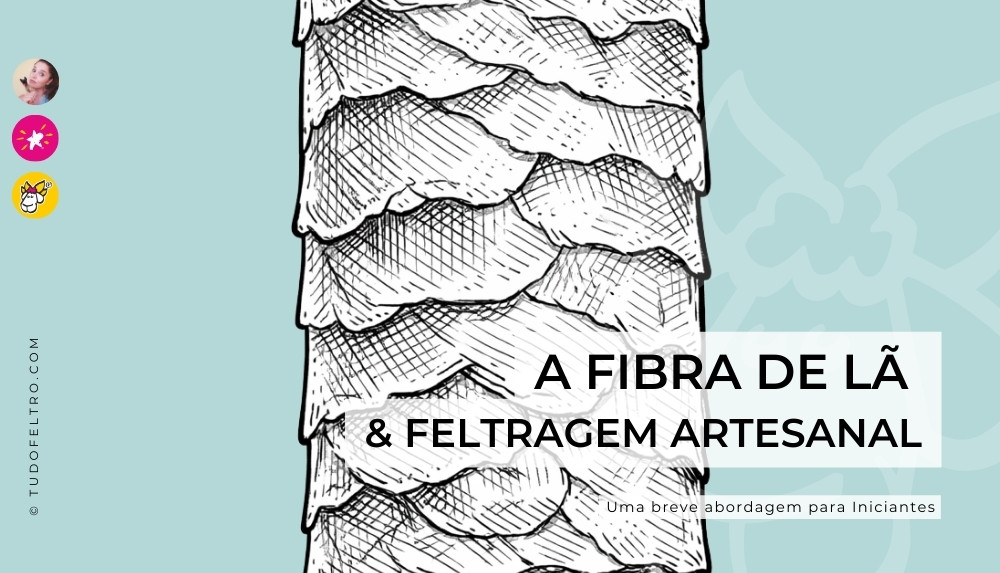
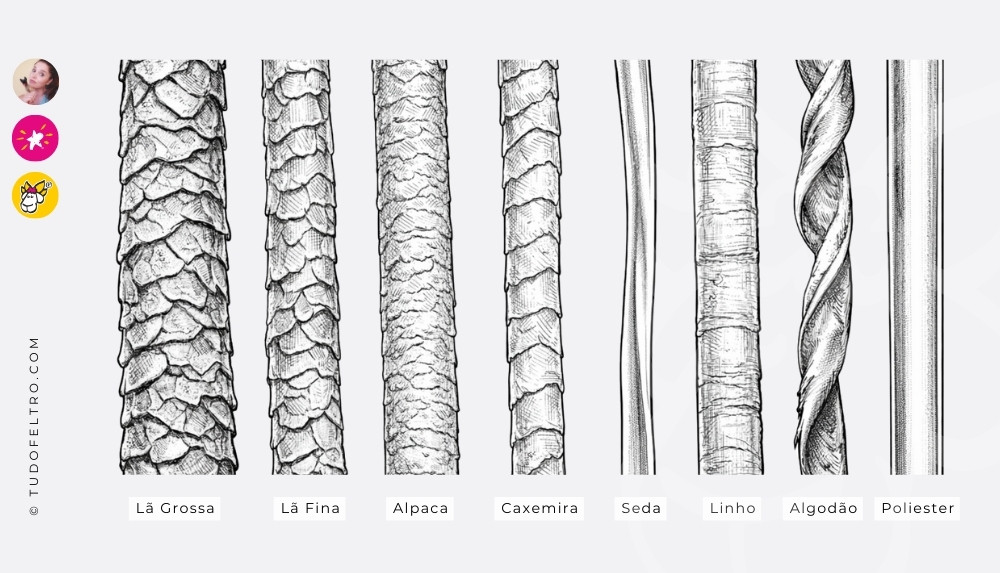
Wool is an incredible natural fiber, extracted mainly from the fleece of sheep (although it also comes from other animals such as alpacas or goats). Composed of keratin — the same protein found in your hair — each wool fiber has microscopic scales on its surface. These scales are what make felting possible: when there is friction, heat, or moisture, the fibers “grab” onto each other, compacting and forming a dense, cohesive material.
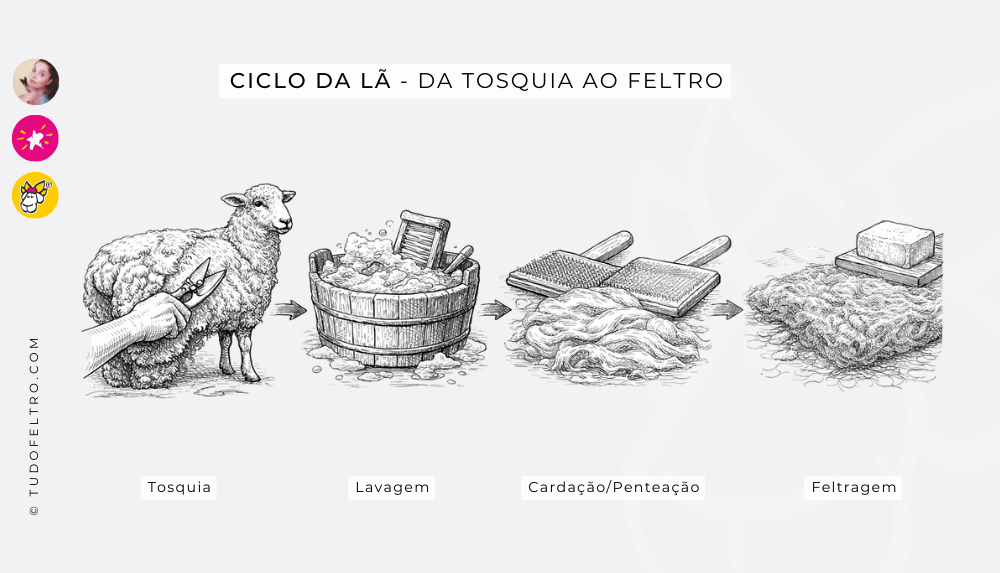
This makes wool ideal not only for needle felting (where you use needles to poke and shape), but also for wet felting (which involves water and soap to create friction) and nuno felting (a fusion of wool with fabrics such as silk). Beyond artisanal felting, wool is also used for spinning, weaving, and clothing production.
But what makes wool so special? Here are some of its unique properties:
- Regulates temperature: Keeps you warm in winter and cool in summer.
- Absorbs moisture: Can retain up to 30% of its weight in water without feeling wet.
- Fire‑resistant: Only ignites at extremely high temperatures (570–600°C).
- Naturally antimicrobial: Resists bacteria, mold, and odors.
- Biodegradable and sustainable: It’s renewable and part of Earth’s natural cycle.
- Durable: A single fiber can bend 20,000 times without breaking.
For beginners in artisanal felting, understanding these qualities helps explain why wool is superior to synthetic fibers — it’s alive, breathable, and eco‑friendly!
Types of Wool: Fine, Medium, and Coarse – Which One Should You Choose for Felting?
The quality of wool is measured in microns, which indicate the diameter of the fiber. The lower the micron count, the softer the wool. Let’s break it down into categories to make it easier:
- Fine Wools (16–21 microns, e.g., Australian Merino):
Super soft, shiny, and smooth to the touch. Perfect for delicate pieces, especially those that come into contact with the skin. They are widely used in artisanal felting for clothing or accessories in Wet Felting and Nuno Felting. Ideal for those seeking professional and elegant results, but not recommended for beginners or for Needle Felting, as the fine, delicate fiber felts more slowly.
- Medium Wools (22–27 microns):
Soft, voluminous, and very versatile. Perfect for most artisanal felting projects, tapestries, and other craftwork, as they maintain an excellent balance between softness and structure. They are widely used in Needle Felting and Wet Felting because they felt quickly, compact consistently, and allow you to create firm, well‑defined pieces. Ideal for anyone looking for wool that is easy to work with, accessible, and delivers stable results. They also work well in Nuno Felting when more texture and body are desired in the fabric.
- Coarse Wools (28+ microns):
Strong, rustic, and full‑bodied, these wools are ideal for structured and durable pieces such as rugs, bases, sculptures, and large, robust 2D and 3D decor in Wet Felting. They offer firmness and pronounced texture, but are not suitable for delicate details, direct contact with the skin, or for Nuno Felting due to their rougher texture and lower ability to bond with fine fabrics.
Tip for wool enthusiasts:
For most artisanal felting projects, choose wools between 22–27 microns. They felt quickly, hold their shape, and allow fine details — especially Lã Mágica ®, the star of felting!
Combed Wool, Carded Wool, and Handmade Felt: Essential Differences in Felting
1. Combed Wool (Top or Combed Wool)
Combed wool goes through a combing process that removes short fibers, aligns the long ones in the same direction, and creates smooth, shiny strands.
- Characteristics: Soft touch, parallel fibers, low volume, long‑lasting.
- Uses in Artisanal Felting:
- Needle Felting: Ideal for smooth or blended surfaces, fine details (such as hair or dresses on Waldorf‑style fairies), and pieces with movement.
- Wet Felting: Creates uniform and elegant layers, such as in hats or scarves.
- Nuno Felting: Bonds perfectly with fabrics, giving a fluid and professional finish.
- Why is it special? It felts in a controlled way, perfect for beginners who want precision.
2. Carded Wool (Carded Wool or Batts)
Here, carded wool is “brushed” to create a batt made of multiple layers of crossed fibers with a voluminous appearance.
- Characteristics: Fluffy, voluminous, felts very quickly, creates compact textures.
- Uses in Artisanal Felting:
- Needle Felting: Great for bases, sculptures, and large surface panels.
- Wet Felting: Perfect for dense pieces like bags or rugs, where water friction compacts everything with ease.
- Nuno Felting: Adds volume and texture to fabrics, ideal for creative accessories.
- Tip for beginners: Start with carded wool if you want fast and motivating results!
3. Handmade Felt (Sheet or Plate)
Felt is the final result of felting: wool that has been rubbed, compressed, and shrunk until it forms a dense, stable, seamless fabric.
- Characteristics: Strong, water‑resistant, durable, and seamless.
- Uses in Artisanal Felting:
- Serves as a base for all techniques — embroider/paint on it with needle felting, layer it in wet felting, or integrate it into nuno felting.
- Examples: Rugs, hats, bags, or decorations.
- Fun fact: Handmade felt is one of the oldest textile techniques in the world, used for thousands of years to create strong, functional pieces without weaving. Many traditional cultures used felt to make shelters, rugs, and durable clothing.
Tip: Mixing different types of wool and techniques is a common and creative practice in artisanal felting.
- Needle + Wet Felting: Shape the form with a needle and then compact it with water for greater firmness.
- Needle + Nuno Felting: Add details, reliefs, or decorative elements on felted fabrics.
- Wet + Nuno Felting: Creates rich surfaces with movement and fiber integration into fabric.
Creative advantage:
Combining materials and processes allows for better control over the final result — from very smooth and delicate pieces to rustic, dense, or highly textured work.
Wool as a Sustainable Fiber in Artisanal Felting
Wool is one of the most sustainable natural fibers used in textile crafts. It is renewable, biodegradable, and comes from a resource that regenerates annually without the need for intensive industrial processes. In addition, it offers exceptional durability, which extends the lifespan of pieces and reduces waste.
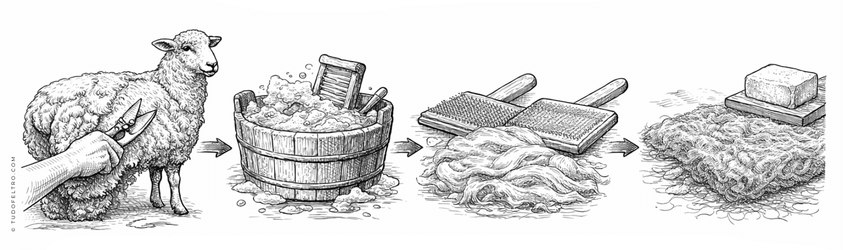
Unlike synthetic fibers, which release microplastics and rely on fossil fuels, responsibly sourced wool has a significantly lower environmental impact. When discarded, it decomposes naturally, returning nutrients to the soil. Its production can also support local economies, small farms, and animal‑welfare practices.
In artisanal felting, wool stands out for allowing the creation of seamless, durable, and repairable pieces, promoting more conscious consumption. It is a fiber that values handcraft, creativity, and sustainability — a choice aligned with ecological practices and the preservation of traditional knowledge. It is a way of creating art without harming the planet — EcoDesign!
Surprising Wool Properties That Will Impress You
Wool is a natural fiber with such advanced internal engineering that it continues to surprise even those who work with it every day. Its protein structure, composed of keratin and cuticle scales, gives it unique characteristics that make it one of the most versatile, functional, and sustainable fibers in the textile world.
Here are the properties that impress artisans and specialists the most:
- Fire‑resistant — it only burns above 570–600 °C, while cotton ignites at around 255 °C.
- Highly hygroscopic — absorbs up to 30% humidity without feeling wet.
- Naturally antimicrobial — prevents mold, bacteria, and bad odors.
- Hypoallergenic — dust mites dislike wool, making it ideal for sensitive people.
- Exceptional resilience — returns to its original shape after being stretched or bent; a fiber can be bent 20,000 times without breaking.
- Advanced thermal regulation — warms in the cold and cools in the heat, thanks to its ability to manage moisture and temperature.
- 100% sustainable — it is biodegradable, renewable, and naturally part of the carbon cycle.
- Natural and chemical‑free — does not require harsh treatments like many synthetic fibers.
These properties make wool a premium raw material for artisanal felting, allowing the creation of durable, comfortable, functional pieces with superior performance. Working with wool is a blend of tradition, science, and sustainability — a smart choice for those who value quality and reduced environmental impact.
FAQ: Frequently Asked Questions About Wool and Artisanal Felting
1. What is wool fiber made of?
Wool is composed mainly of keratin, a structural protein organized in layers (cuticle, cortex, and sometimes medulla). This composition gives it elasticity, strength, shape memory, and the ability to felt.
2. Why does wool felt?
Felting happens due to the cuticle scales that cover each fiber. With friction, heat, and moisture, these scales open and interlock, creating a dense and compact structure — felt.
3. What does “microns” mean?
“Microns” (µm) measure the diameter of the fiber.
- Low microns = finer, softer, more delicate wool.
- High microns = coarser, stronger, more structured wool.
This measurement influences texture, felting speed, and the ideal type of project.
4. Can I felt synthetic wool?
No. Synthetic fibers do not have cuticle scales and therefore do not felt. They can only be used as stuffing or support, but never as the main fiber for felting.
5. Does wool always shrink?
Yes. During felting, wool shrinks and densifies, but the degree of shrinkage depends on the fiber type, micron count, technique, and intensity of friction.
6. Does handmade felt last a long time?
Yes. Wool is extremely durable, elastic, and repairable. Well‑made felt can last for decades, maintaining its shape and strength even with frequent use.
7. Can wool irritate the skin?
It depends on the microns. Finer wools (18–23 µm) are more comfortable; coarse wools may feel itchy but are not allergenic — dust mites avoid wool.
8. Why does wool regulate temperature so well?
The fiber has an internal structure that traps air and absorbs moisture, allowing it to insulate in the cold and release heat when it’s warm.
9. Is wool technically sustainable?
Yes. It is biodegradable, renewable, durable, and part of the natural carbon cycle. It decomposes in the soil without microplastics and does not require harsh chemicals to function.
10. Do all wools felt the same way?
No. Fine wools felt more slowly and create smooth surfaces; medium and coarse wools felt quickly and create more compact textures. The choice depends on the desired effect.
Glossary for Beginners in Artisanal Felting
Micron: Measurement of the thickness of wool fiber (diameter). The lower the value, the finer and softer the wool.
Combing: Process that aligns long fibers in the same direction, creating combed wool (top/roving).
Carding: Process that crosses the fibers and creates voluminous batts, ideal for fast felting.
Wool Top: Continuous strand of combed wool with parallel fibers and a smooth finish.
Wool Batt: Sheet of carded wool with crossed fibers in layers and a more voluminous texture.
Handmade Felt: Compact fabric created through friction, heat, and moisture, without weaving.
Final Considerations
Artisanal felting is much more than a technique — it is a form of expression that combines fiber science, tradition, and creativity. The more you understand wool, its properties, and the behavior of each method, the more freedom you gain to transform ideas into unique pieces.
Exploring different types of wool, experimenting with textures, testing combinations, and observing how the fiber reacts to touch is an essential part of the journey. Each project is a discovery, each piece a small creative laboratory.
If you’re just starting, take this moment to explore without rushing. If you already have experience, keep deepening your technical mastery and challenging the limits of the fiber. Felting is a continuous process of learning — and that’s what makes it so special.
Now that…
you understand wool, the techniques, and the potential of artisanal felting better, this is the perfect moment to continue your creative journey and deepen your mastery of this art.
Additional Resources
- Check out our recommendations of Wool Packs and Learning Kits, carefully selected to ensure consistent and professional results.
- Sign up for our felting workshops/courses to learn exclusive techniques and grow with expert guidance.
Don’t miss the chance to discover everything felting has to offer. Creativity is in your hands — literally!
Start today and transform your ideas into stunning handmade pieces.
-100x100.png)



Write a comment